Randy Cantrell

Randy Cantrell is the founder of Bula Network, LLC - an executive leadership advisory company helping leaders leverage the power of others through peer advantage, online peer advisory groups. Interested in joining us? Visit ThePeerAdvantage.com

Customer Base- The Foundation Of Any Business #4024 - GROW GREAT

Customer Base: The Foundation Of Any Business #4024

Customer Base- The Foundation Of Any Business #4024 - GROW GREAT

I’m too old to remember my first repeat customer, but I’m not so old that I can’t remember how powerful it was to have customers who’d come back and buy from me again, and again. Like most people with a sales background I was basically lazy. Repeat business fueled my inner passion to not work any harder than necessary. The effort exerted to persuade somebody to buy from me once, was at least twice (maybe three times) harder than it was to repeat that process. Enter the power of building a solid customer base!

How can more business owners fail to understand the power of it?

That’s easy. We need sales today. That whole “what have you done for me today” mindset has set up harder than the concrete foundation that serves to illustrate today’s episode. Too often we concentrate on making the cash register ring today (okay, I know we don’t all have cash registers, but it’s still the metaphor for getting customers…or actually, for making a sale). I was still a teenager when I learned that businesses can chase all sorts of things, but chasing cash is the worst one of all. Customers, inventory, employees — we have to chase many things and succeed in catching them. But nothing is worse than chasing cash. It fuels a desperation that every business person has experienced at some point in their life.

Short-term thinking sparks us to concentrate on getting customers today. Sometimes it compels us to be too transaction oriented, losing sight of the value we need to provide to our prospective buyers. As we focus on making the register ring today we can neglect to pay close enough attention to the clients who are running from us out the back door. Intently focused on the front door, we just care about getting new bodies in so we can make our cash flow dreams come true.

Problem: it’s a never-ending story!

Like the worse drug addiction, business owners grow addicted to new customers. Ask ten business owners about their existing customer list, “When you did last reach out to them?” — and quite often the response is, “Oh, I don’t know. It’s been a little while.” Probe a bit more and ask them to provide you a print out of their best customers and you’ll quickly see how little they focus on people who have purchased from them in the past. I know because I do it with some regularity and the responses are almost always the same. “I’m sure I could get that for you,” is the most common refrain I get when I ask an owner if they have a list of their best clients. Those same owners can much more easily tell you what yesterday’s sales were, or even what today’s sales are so far. All eyes are on the front door!

Pour a slab, a foundation. What’s next? Frame it up. Finish it out. At some point we’ve got windows and doors. Doors give us entry to the building. And exit.

Yet we can more easily focus on getting new customers – the entry – and not focus much at all on serving existing customers BETTER – so we can prevent customers from leaving us! Have you ever watched an episode of Gold Rush, that Discovery Channel show about gold miners up in Alaska? One of the worst things that can happen to a gold mining operation is for the sluice box (the contraption that is designed to catch the gold) to malfunction and let gold pass through. It’s money going down the drain (or out in the wash).

That’s what happens when we don’t pay attention to existing customers! Focus on loading more payload into the front end of the process — like gold miners who make sure they’ve got enough dirt to wash — and you may soon discover there’s no gold coming out the other end. No customers. No customer base.

A critical component of building a great business is developing systems that will effectively bring in new customers while simultaneously continue to dazzle the existing customers. Great businesses know how to do both at the same time. So why don’t more businesses focus on both of these? Why do some take their eyes off of customers as soon as payment is received, or services/goods are rendered?

Because they fail to see the true benefit of customers who have already said, “Yes.”

Because they don’t know the true lifetime value of a customer.

Because they’ve developed a system for attracting/getting new customers, but they’ve not developed one for hanging onto existing customers.

Because they think new customers are more valuable than existing ones.

There are likely many other reasons. None of them make any sense though because they all erode the customer base. It’s a common plight of businesses that are too focused on transactions, not customers.

It’s the siren call of the cash register. We get lured by the quest for new money. Meanwhile, the old money is walking or running out the back door taking their business to a competitor.

What’s The Value Of Existing Customers?

A: They already said YES to us.

You forgot that. All that hard work you put into attracting potential customers, and all the effort spent showing prospects why you are the ideal solution…that’s already been done with existing clients. They already experienced it and found you were worth the investment. You don’t have to go back to square one and try to attract them. It’s ground you already plowed, planted, fertilized and watered. You’ve likely neglected it so it’s going to require some effort to get the soil in good shape again, but that’s doable. Tend your garden.

B: They have feedback that will help us improve and grow.

Because existing customers have been through the process with us, they have a unique perspective. We can tap them for insights into ways we can do better. Refusing to have meaningful conversations with them is a lost and wasted resource that might make all the difference in the world in us experiencing growth or failing to grow. All because we simply didn’t ask the questions that could have helped us.

Find out from your existing customers what the experience felt like. Ask them why they bought from you. Ask them what went well…and what didn’t. Too often we’re nervous to have conversations with existing clients because we’re fearful they’ll aim a double-barrel shotgun at us and blast away with complaints and issues. Don’t fear that. Embrace it. Be hopeful you’ll get a few of those blasts because it’ll mean you can fix the problem.

C: The dissatisfied and unhappy existing clients can often become our most loyal advocates.

An existing customer with a problem is one of the biggest opportunities we’ve got. See it for what it is. Don’t shy away from it. Lean into it. This may be the first you’re hearing of it (likely if you’re not in the habit of checking in on existing customers regularly). Then, gather the facts, ask permission to look into this to see what you can do to fix it, then agree on a time when you’ll get back with them. Keep your word at every step. You’re trying to fix a problem and create the most loyal advocates you’ll ever have for your business. That’s because this client will have seen how you respond to problems. Most customers don’t see or experience that. It’s powerful so don’t neglect to use it fully.

A customer who is unhappy and willing to tell you about it can be turned into an advocate if you’ll handle it well. For starters, don’t get defensive. Acknowledge their pain and disappointment.

Next, apologize. Be genuinely apologetic about their experience. Don’t humor them. Don’t scold them. Don’t blame them. Accept full responsibility.

Then, assure them you’re going to fix it (but ONLY if you really intend to). Too often this is where I see businesses fail. They do pretty well up to this point, then implode by making a bad situation worse. They promise to fix it, then fail. Better to not promise, than to promise and not deliver! Be careful.

Ask the client what you need to do to make them happy. Failure to do this is equal to being offended by somebody only to have that person tell you exactly what they’re going to do to remedy the offense. No, YOU were offended. The terms of reconciliation are squarely on your shoulders, not theirs. But when it comes to customers we want to decide what we’re going to do to make them happy. All without ever asking them, “Mr. Customer, what would it take for me to make you thrilled?” Ask.

If you can remedy it on the spot, do it. Don’t delay. Business owners and other top leaders have the power to hit the Happiness Button for the customer immediately. Do it. Think as they’re telling you what they’d like — about how you’ll executive it, about how much it may cost (and I don’t mean in full profit costs, but in real hard raw costs to you) and make a decision. I’m not a fan of negotiating this, except in extreme circumstances where sometimes (rarely in my experience) I encounter an existing customer who is completely unreasonable. In over 40 years of running businesses I can count on one hand the number times that’s happened though. It’s rare. Most people are very reasonable and more often than not I encounter a proposal that is less than what I would have done otherwise.

Go above and beyond if you can. After the client tells you what you can do to recover, think seriously (and quickly) about dazzling them. It’s analogous to what Bible students often call “second mile religion” taken from Matthew 5:41, “And whosoever shall compel thee to go one mile, go with him two.” That’s where get that phrase, “going the extra mile.” Do that with your existing customer who is disappointed.

If you’re able to exceed their request, do it. Don’t overthink it. Don’t over calculate it. Remember, this person is going to tell everybody they know. And in the day of social media, that might mean many more people than you think. You can’t view this in isolation. This isn’t just a single client we’re talking about. It’s your company and what your company represents. It’s reputation. Handle it with great care.

D: Existing customers want to buy more.

Most people put this up front. I put it last because it’s important, but it fosters too much self-serving behavior. I’d encourage you to focus on how you’re robbing existing customers of more services, products or whatever it is you DO. By neglecting them you’re not serving them well. Worse yet, you may be forcing them to search elsewhere to remedy a problem you could more easily fix for them. You’re an existing and known supplier. That gives you a cost advantage even if your prices are slightly higher — a time cost advantage. Your customer doesn’t have to get to know you, or trust you. They don’t have to go through the vetting process, or the trust building process. That’s worth money to them. You owe it to them to be there when they need you without forcing them to chase you down. It’s your job to be on the forefront of knowing their needs as they happen in real-time. That means you have to drive the bus in this relationship. Take charge. Be of service.

Solid Business Growth Hinges On A Solid Foundation

The bigger the building, the stronger the foundation required. The same is true with our businesses. You can pitch a tent anywhere. It’s not a sustainable structure. We’ve got too many businesses being run by tentmakers. Anybody can make one sale, or 100. Can you keep making sales? Can you make people happy. Consistently, over time. Sustainable is the minimum bar you must jump. You’ve been doing that. That means you continue to find new customers willing to let you serve them. That’s excellent, but that’s not providing a solid customer base, or foundation.

Strengthen your foundation for quantum leap growth by making sure you’re dazzling customers over and over again. Start judging yourself more strictly on how many people agree to do business with you a second, third or fourth time. Close that back door and stop letting customers leave you to find a solution elsewhere. That’s how you’ll grow your business!

I know it’s not complex, sophisticated or filled with buzzwords that prove how smart we can be. That’s because business building isn’t effective with all that stuff. The guys who pour the slab have to get a few fundamental things just right. It’s not complex, sophisticated or filled with buzzwords. It’s doing the right thing the right way. Period. Go to work!
Randy

Subscribe to the podcast

bula network podcast on itunesTo subscribe, please use the links below:

If you have a chance, please leave me an honest rating and review on iTunes by clicking Review on iTunes. It’ll help the show rank better in iTunes.

Thank you!

Customer Base: The Foundation Of Any Business #4024 Read More »

Momentum- How To Get It, How To Keep It #4023 - GROW GREAT

Momentum: How To Get It, How To Keep It #4023

Momentum- How To Get It, How To Keep It #4023 - GROW GREATMomentum Monday.

Is that how you view Mondays? Most don’t.  It’s time for you to stand apart from the crowd.

Today’s show is a quick 15 minute episode recorded while out and about hustling. Pardon the less than studio-like sound quality, but hopefully the message is one to spark inspiration as you start a new work week.

Prompted by my passion for Stanley Cup hockey and business, I’ve had conversations about momentum in the past week. Those talks provoked me to hit the record button on my iPhone while out and about today, hoping to avoid the thunderstorms looming here in DFW.

Enjoy.

Randy

P.S. Today’s show was recorded with my earbud microphone (JBL Inspire 300 Yurbuds).

Subscribe to the podcast

bula network podcast on itunesTo subscribe, please use the links below:

If you have a chance, please leave me an honest rating and review on iTunes by clicking Review on iTunes. It’ll help the show rank better in iTunes.

Thank you!

Momentum: How To Get It, How To Keep It #4023 Read More »

Leadership Challenges 004- Giving People A Story (Congruency) - GROW GREAT

Leadership Challenges 004: Giving People A Story (Congruency)

Leadership Challenges 004- Giving People A Story (Congruency) - GROW GREAT

Today’s fictionalized story is real. These things really happen all over the world in every industry. People woke up this morning, got ready to go to work and arrived without knowing how their work matters — or fits.

Too many offices need a sign warning employees that…

the talk may not match the walk

Few things create higher disengagement than a lack of congruency in the work place. Bosses say one thing, but do something different. It creates a tension and stress among workers that must find resolution somewhere. Today’s short story is just one employee’s way to resolve it in her own life. There are at least two lessons we can all learn from it. I hope we learn them well. Our businesses deserve it so we can grow great.

Randy

Subscribe to the podcast

bula network podcast on itunesTo subscribe, please use the links below:

If you have a chance, please leave me an honest rating and review on iTunes by clicking Review on iTunes. It’ll help the show rank better in iTunes.

Thank you!

Leadership Challenges 004: Giving People A Story (Congruency) Read More »

What’s Killing Leadership Growth? Isolation In The C-Suite #4022

What's Killing Leadership Growth? #4022 - GROW GREAT

Few things are worse than not knowing. Maybe not knowing the truth? Or not seeing things as they really are?

Thoreau said, It’s not what you look at that matters, it’s what you see.” Maybe he was right. He certainly had a point worth thinking about.

Lately I’ve encountered frustrated business owners and CEOs who felt a greater degree of success was ahead of them. They just found themselves struggling to get past their current plateau.

Plateaus aren’t bad. In fact, they’re a necessary part of growth and mastery. But they can be exhausting. Especially when it seems like you’ve been there for too long and you’ve no idea how much longer it’ll last. Funny thing about plateaus…they last however long they last. The key is to push through, persist and use them to make you more tenacious.

It’s hard work though. Snarliness, toughness and all those other words I love so much that indicate how hard we are to compete against — they demand a resilience that only comes from lots of slogging through the plateaus of your career and your company. The greatest business leaders do it. It doesn’t mean they enjoy it all the time, but they use it for their advantage.

Today I’d like to focus on just one element of the plateau that seems especially vicious – the isolation. Business owners and CEOs can be among the most isolated people on the planet. And that’s under normal conditions. Tasked with one decision after another, armed with reams of data and sometimes listening to hours of internal arguments among direct reports — and then add on for good measure all the outside influencers with some agenda or consideration they think is vital to our decision-making — the isolation we can feel is quite crowded and noisy. We’re surrounded by well-meaning people. Why do we often feel isolated?

Because we’re the chief decision maker. And because our decisions have the biggest impact on the company – for good, or bad. That’s the subject of today’s show. Enjoy!

Randy

Subscribe to the podcast

bula network podcast on itunesTo subscribe, please use the links below:

If you have a chance, please leave me an honest rating and review on iTunes by clicking Review on iTunes. It’ll help the show rank better in iTunes.

Thank you!

What’s Killing Leadership Growth? Isolation In The C-Suite #4022 Read More »

YOU Are The Reason People Are Quitting Their Jobs #4021 - GROW GREAT

YOU Are The Reason People Are Quitting Their Jobs #4021

It’s not me. It’s YOU.

That’s not what people say when they break up. Or when they quit their job. Well, not often.

Mostly, people aren’t confrontational. They just want to get away with little fuss. So when people quit they’re prone to forego candor. Instead, they may blame quitting on all kinds of things. Some just walk away without warning. Others sneak away quietly due to some family emergency or other contrived excuse. Anything to avoid a show down.

It’s all just as well. Bluntness wouldn’t likely do any good. And it might hamper the future prospects of the quitter. It’s a no win situation – being candid about why you’re really quitting! Besides, the person you’d have to be candid with about it is the culprit himself – the boss. He’s the reason you’re leaving.

Best to leave in the most gracious way possible by saying as little as possible.

YOU Are The Reason People Are Quitting Their Jobs #4021 - GROW GREAT

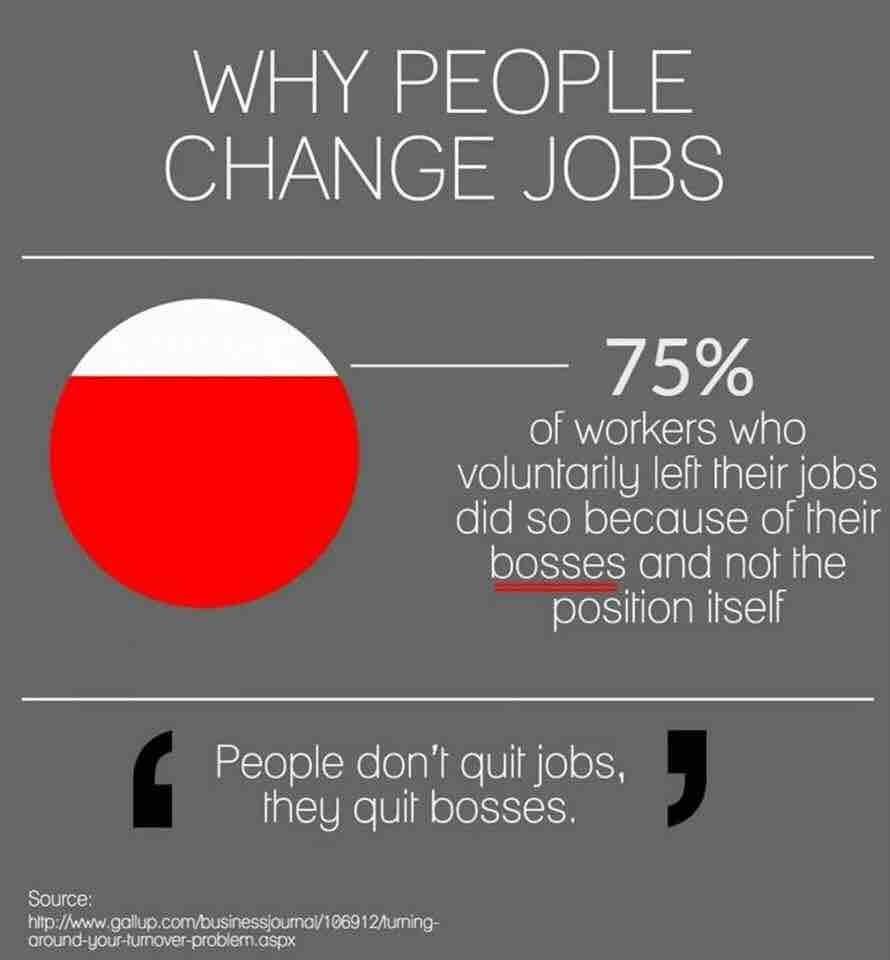
Almost 8 years ago Jennifer Robison, Senior Editor of The Gallup Business Journal wrote an article entitled, Turning Around Employee Turnover. The article lists the top 5 predictors of employee turnover.

The Top Five Predictors of Turnover

Work units with high potential for turnover send out warning signals, according to Gallup research, but managers and executives must know where to look:

1. The immediate manager. If employees report that their manager’s expectations are unclear; or that their manager provides inadequate equipment, materials, or resources; or that opportunities for progress and development are few and far between, watch out: Trouble is on the way.

2. Poor fit to the job. Another sign of trouble appears when employees perceive that they don’t have opportunities to do what they do best every day.

3. Coworkers not committed to quality. Watch for employees who perceive that their coworkers are not committed to a high standard of work.

4. Pay and benefits. Engaged employees are far more likely to perceive that they are paid appropriately for the work they do (43%), compared to employees who are disengaged (15%) or actively disengaged (13%). And pay and benefits become a big issue if employees feel that their coworkers aren’t committed to quality; they may feel entitled to extra compensation to make up the difference or to make them feel like they are truly valued by their employer.

5. Connection to the organization or to senior management. Another key sign that turnover may be looming appears when employees don’t feel a connection to the organization’s mission or purpose or its leadership.

Source: Gallup research, including meta-analysis, employee opinion polls, and exit interview studies conducted over the past 30 years

Who cares? So what if people come and go in your company?

YOU should care because there’s a big cost to employee turnover. Again, according to the Gallup article…

The U.S. Bureau of Labor Statistics has found that the U.S. voluntary turnover rate is 23.4% annually. It’s generally estimated that replacing an employee costs a business one-half to five times that employee’s annual salary. So, if 25% of a business’ workforce leaves and the average pay is $35,000, it could cost a 100-person firm between $438,000 and $4 million a year to replace employees.

Still don’t think it matters if Joe walks out? Too many bosses don’t care. They think people are plug ‘n play interchangeable parts. Joe leaves. Jim enters. Jim leaves. Josh enters. Josh leaves. Jill enters. Of course, it all started with Abe. Over the course of three decades the organization is fast approaching the end of the alphabet. Then it all starts over again. Hundreds of thousands of dollars in lost dollars and productivity to even a small business. Millions of dollars to a larger enterprise.

If you think VC money often goes down the drain – and it does – then you need to consider the high price of human capital. Millions of people are going down the drain every day in organizations all over the world. It’s not because they’re bad people, or unskilled, or unproductive. It’s because they’re working for a jerk and they just can’t stand it any more.

The High Price Of Employee Turnover

How do you make a boss care? You don’t. Truth is, you can’t make a business owner, a CEO or any other boss care about something. You may be able to persuade them why they should care. You may be able to influence them with compelling data, or an engaging story that just might convince them it’s in their best interest to care. But they have to care about people enough to create a culture that fosters superior human performance. Higher human performance should be the priority of every CEO. Should be, but it’s not.

Lower levels executives – even mid-level bosses – can often behave with greater disdain than the disinterested CEO. Disinterested in making sure people are properly trained, coached, encouraged, rewarded and held accountable. Not caring if people leave and not caring why they leave is the mark of a boss who should not be the boss. They’re destructive to their enterprise. No amount of process management proficiency can outweigh the greater rewards of higher human performance. It’s simple math. One boss can destroy the work of everybody who reports to her. She can’t possibly perform alone at a high enough level to outweigh her damage…even if she’s only got a handful direct reports. The more people she has reporting to her, the greater her damage.

The problem seems complex because of how varied we are as humans. One boss tasked with leading some number of other people is outnumbered. Just like the coach of a professional sports team has one personality, style and philosophy is asked to coach up to dozens of players who are all very different. They’re different from the coach, and from each other. So the challenge is figuring out how to best lead the entire group – the whole team – and to also lead each individual player. Quite frequently professional sports has it more right than business. They fire the coach and keep the talent. We tend to let the talent walk away refusing to consider that the boss is the reason. Pro sports views it from a more economical and practical model. It’s easier to replace the boss than it is to replace major chunks of the team (talent). Businesses don’t tend to see it that way. We often choose to diminish the value of the player because we think that enhances our own worth. We’re wrong. Expensively wrong. Stupidly wrong.

Once upon a time I’d try to evangelize every leader who seemed disinterested in his employees. Over time I made adjustments to that strategy. Mostly because I found it futile. Not always, but mostly.

Emerging leaders – those folks flying at lower altitudes, sometimes early in their management careers – often seemed more open-minded to the logic (and heart) of treating people well. Well doesn’t mean easy. Nor does it mean without confrontation or accountability. It means doing the right thing to help people succeed. It means behaving toward employees so they can become the best versions of themselves. I’d dive into a series of questions aimed at discovering the cost (the overall toll) of employee turnover. Oddly enough, I found lower level leaders could more easily see the business reason to put people first than the chief leader, who most often was steeped in a long-held philosophy of not caring so much. If the person at the top had such a strong personality of not caring, then it was sure to be difficult to convince lower level leaders to hold a contrary philosophy. After all, the chief’s direct reports want to please him. Being like him in philosophy and behavior can be a safe career move.

As much as I believe in a skunkwork (a term made famous by Lockheed Martin), there are severe limitations to grass roots works. Most of us use the term to mean some under the radar, secret endeavor or initiative. Sometimes it may be a bottom up sort of thing. As valuable as those may be, they’re ineffective compared to an initiative fostered by the top dog. When the CEO speaks, everybody listens. Lower level folks can scream and shout and still the boss may not hear it. Or care.

Sadly, nothing trumps voting with your feet. That’s why employees working for a jerk quit. Not all of them, of course. Some are trapped. I’m thinking of all the stories I’ve heard throughout my life of single parents who simply need a job — and lost their self-confidence long ago. They’ve been fooled into thinking they have no other options except to endure the bad boss. They stay. Dwarfing their development with every passing day. De-energized by the environment and their boss. But hey, it’s a paycheck. And that’s what they need most.

When a person quits the bad boss says, “Good riddance!” Without hesitation or concern they quickly move on with the philosophy of Shark Tank star Kevin O’Leary – “You’re dead to me.”

That’s exactly why they’re losing people. They just don’t care about others. Self-centeredness prevents them from seeing the value of high human performance. It’s all about them. The quitters have forsaken them, betrayed them and created more work for THEM. They see leadership as a position that deserves to be served – not a position that deserves to serve! A stark difference between being the recipient of service or the purveyor of service. Leadership is a position of service. The higher the position, the more powerful the service rendered.

Today, I focus on working with CEOs and top leaders who understand this – and who see the world as I do. It’s more profitable to pass on the philosophy that organizations are best built by using the highest human performance possible. And by finding ways to continue to elevate it. It’s building an A team, then maintaining a culture committed to superior performance. It’s not easy work, but it’s the most profitable way to go. Nothing will elevate an organization’s performance faster, or more, than leveraging the people who do the work. You don’t have to believe me. In episode 4019 I referenced two leaders who operate multi-BILLION dollar businesses. They see people as their greatest asset. That’s what I’m urging you to do, even if it’s contrary to how you’ve been operating.

As always I just hope to provoke you to think about what you do. And why. Re-examine things. As the boss, you’re constantly asking people to improve. All I’m asking is that you devote yourself to the same thing – your own improvement. Stop letting talent run out the door. It’s preventable. It’s up to YOU to stop it because too often, YOU are the reason for their leaving.

Randy

P.S. Here are some articles from this week to provoke further thought:

Subscribe to the podcast

bula network podcast on itunesTo subscribe, please use the links below:

If you have a chance, please leave me an honest rating and review on iTunes by clicking Review on iTunes. It’ll help the show rank better in iTunes.

Thank you!

YOU Are The Reason People Are Quitting Their Jobs #4021 Read More »

You Can't Offer A Solution Without Asking Questions #4020 - GROW GREAT

You Can’t Offer A Solution Without Asking Questions #4020

You Can't Offer A Solution Without Asking Questions #4020 - GROW GREAT

Thousands of salespeople have sat across from me throughout my career. Some were very good. Most weren’t. Not because they lacked ability, but most lacked what I valued most while leading a company – somebody who really wanted to help me grow my business.

Self-interest is what drives far too many salespeople – and others, for that matter. What’s in it for me? That’s our collective battle cry. I’m okay with it provided we help the other person get what might best help them first. Mutual benefit should be the objective.

Countless sales executives have entered my office for the first time ever, armed to the teeth with a bag (sometimes literally) of tricks they claimed would solve my problems. It always fascinated me how a complete stranger who had spent no time with me, or my organization could have such a solution. Or how they could even know what my problems might be. Focused entirely on what was in it for them, they began their pitch with all the reasons why this solution was ideal for me. It was left up to me to decipher whether or not they really did have something I could find valuable.

That’s a bad strategy for problem solving – no matter if you’re selling a solution or not. Well, actually, even people on the executive team are selling a solution. They’re trying to persuade the organization to accept their idea. The value of their solution isn’t enhanced with a “let me tell you why this is good for me” tactic.

Never put the burden on the buyer – whether it’s your boss, a client or somebody else – to figure out if you’ve got something valuable or not. Presenting the value as the buyer would see it isn’t the same as deciding if it’s right for them, or robbing them of the opportunity to decide for themselves. But let’s back up before we even get to the part where you present a solution.

First Things First. Ask. Investigate.

As a young salesman I read and heard sales trainers use a term that never felt quite right to me. Probe.

Probing is what we were taught to do to uncover a customer’s needs, possible objections and anything else that might help us figure out an ideal solution. Not that there’s anything wrong with the term, it just wasn’t a favorite word for me. My natural style was always to simply have an engaging conversation where I asked customers questions. It didn’t take me long to learn that if I could ask the right question, I could find out more about the customer’s desire. That elevated my ability to figure out what I might have to help them. Or it helped me learn I may not have anything that would help them.

I would often imagine somebody who requested an appointment just to find out more about our company, or me before knocking my door down with a “here’s exactly what you need” pitch. It never happened. Periodically (not very often), I’d see some sales executive who I thought might be open to hearing such a message, and I’d run the idea past him. Most were just polite, but only a few – very few – appeared genuinely startled at such a novel approach. Startled to the point where I thought they might actually try it.

These were the day of the one-call-close. Nothing has changed. People today are aiming for the one-call-close. We’re all busy. Our prospects are busy. We think, “We’ve only got one shot.” That’s not true though. And if it is true, then I want to challenge you to do something more valuable with that one shot.

Serve.

You can stand out more by not putting your need to make a sale – that includes you executives who are trying to sell your boss on your idea – at the forefront. Instead, try to gain a clearer understanding of the problem. You can substitute pain, desire, want, need or anything else in the place of the word “problem.” Find the word that best fits your situation.

Every single day I’m talking with CEOs. From very small companies to enormous companies. And I always discover the same thing with any of them willing to talk to me – and most of them are willing. Here’s the simple, but service oriented strategy (which isn’t so much a strategy as it’s simply how I naturally operate):

  1. I spend a few minutes (1-2) telling them why I’m reaching out to them. Don’t play some bait and switch game with your prospects (especially your boss). Be candid. Tell people why you’re wanting to hear their story – why you’d like to ask them questions. It’s not an interrogation. It’s a conversation. Don’t make it a grill session.
  2. I then simply ask them to tell me their story. And I shut up. Most open up quickly – evidence they’re not asked this question nearly often enough. We all care about our story. Most of us wish somebody cared enough to ask us about ours. I do care enough. I’m fascinated by the stories I hear. Most days I hear more than one really compelling story. Amazing what you learn simply by asking.
  3. Then I briefly tell them the truth. Sometimes what I do – or anything I might offer – isn’t a good fit for me. That means it won’t be a good fit for them. Other times, I’m not sure. But it’s not up to me to make the call when I don’t know on my end. If I’m thinking, “This may be something valuable for him, but I’m not sure” — then I’ll tell them that. I don’t try to make the decision for them. They need to make the call.
  4. It leads to more conversation or it doesn’t. Either way, I’m good with that and I’m convinced so are they. We both win regardless of the outcome.

I don’t want to sell. And I don’t think selling or sales is a dirty work. I just don’t want to do what most people think of when they think of selling. They think of talking people into things. Manipulation. That’s not what sales is. It is persuasion and influence – which we all want to incorporate into our communication when we know we’ve got something of value…something that can help others. Mostly, it’s giving people an opportunity to solve their problem (remedy the pain, gain some pleasure, get a solution, etc.).

No Agenda Except To Give Others An Opportunity. And Give Yourself An Opportunity To Serve.

Put first things first. Put your prospect (yes, that means your boss, or perhaps a co-worker, or anybody else you’re trying to serve) first. Listen to them. Better yet, express interest in learning as much as you can about what they think, how they feel and what they want or need. Ask. Listen. Pay attention.

People are searching for solutions. Many are staring into space right this minute, wishing somebody would arrive into their life to help them. What if you could be that person? Why can’t you be that person?

My headline isn’t completely true. You can offer a solution without asking a question. You can offer a solution without even listening to the other person. It will be a terrible experience for you – and the person you’re hoping to sell. But you can keep doing it. And keep enjoying a life of disinterested people. They’re disinterested in your solution because you’re disinterested in them.

You reap what you sow.

Randy.Black

Subscribe to the podcast

bula network podcast on itunesTo subscribe, please use the links below:

If you have a chance, please leave me an honest rating and review on iTunes by clicking Review on iTunes. It’ll help the show rank better in iTunes.

Thank you!

You Can’t Offer A Solution Without Asking Questions #4020 Read More »

Scroll to Top